Tamiya Epoxy Sculpting Putty Review (2026)
Updated September 20, 2026 · Research-based review
Our verdict
Tamiya's epoxy sculpting putty is a two-part filler that cures by chemical reaction rather than by drying, so it fills deep gaps without shrinking back as it sets. It suits builders rebuilding shapes or sculpting small details, though mixing two parts by hand and waiting for a slow cure adds extra steps versus tube putty.
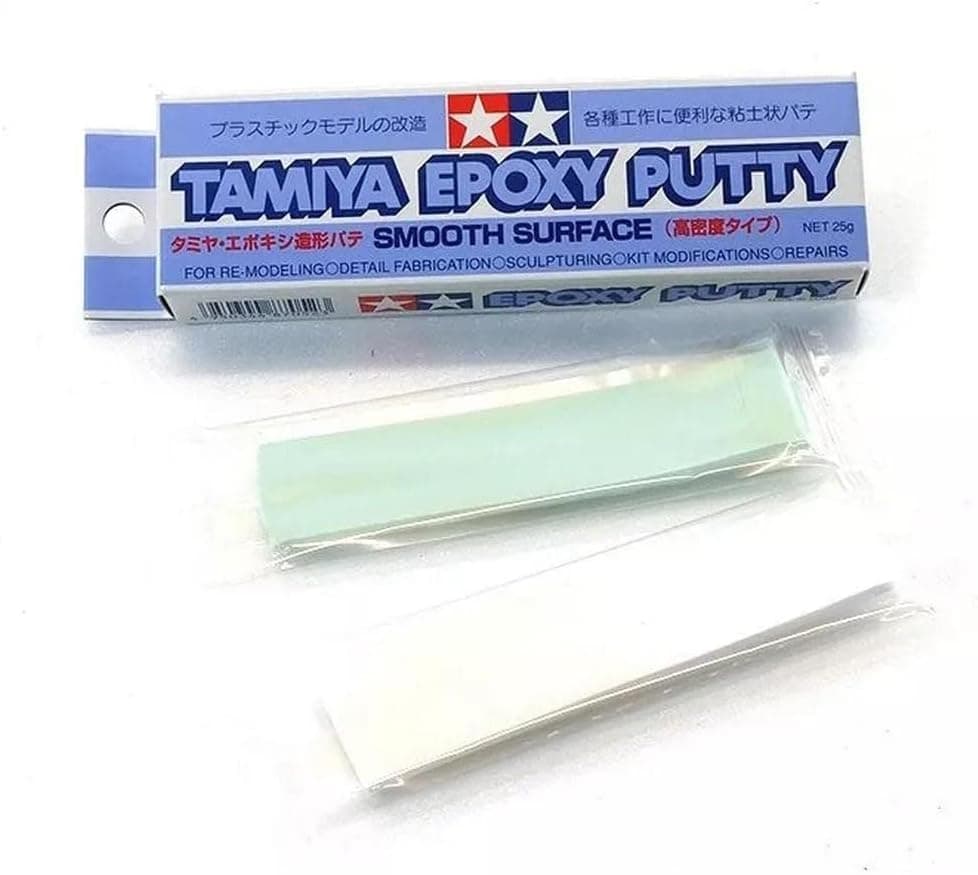
Tamiya Epoxy Sculpting Putty, a two-part filler for bigger gaps, rebuilding shapes and sculpting small details.
Price range: See on Amazon
What we liked
- + Epoxy cure means no shrinkage, even on larger gaps
- + Can be sculpted into missing parts or custom details
- + Smooths with water before curing for cleaner results
Trade-offs
- - Mixing two parts adds a step compared with tube putty
- - Longer cure time delays sanding and painting
How this putty works
Tamiya's epoxy sculpting putty is a two-component product, sold as a base compound and a separate hardener that the builder kneads together by hand in roughly equal amounts before applying it to a model. Once mixed, a chemical reaction begins curing the putty into a solid, sandable material rather than relying on solvent evaporation the way single-part putties do, which is why it does not shrink noticeably as it hardens. This makes it well suited to filling larger gaps, seams or missing sections of a kit where a shrinking filler would leave a visible sink mark after it dries.
Sculpting and shaping before it cures
Because the mixed putty stays workable for a period after combining the two parts, it can be pressed, shaped or built up by hand to recreate a missing panel, rebuild a broken part, or sculpt custom details that are not part of the original kit, which is something most one-part fillers cannot do as effectively. Tamiya notes that the surface can be smoothed with a bit of water on a finger or tool while the putty is still workable, helping to level the surface and reduce the amount of sanding needed once it fully cures. This water-smoothing step is a distinct advantage over solvent-based putties, which typically need to be smoothed with thinner instead.
Cure time and workflow considerations
Tamiya's epoxy putty line cures over several hours depending on the specific type purchased, with the higher-density formulations generally taking longer, often in the range of many hours, before the material is fully hard enough for heavy sanding. That is considerably slower than a quick-drying tube putty that skins over in minutes, so builders need to plan their session around waiting for the epoxy to set rather than filling and sanding in one sitting. The upside of the longer window is more time to sculpt or reposition the putty before it locks in, which favors detail work over speed.
Mixing and handling in practice
Working with a two-part epoxy putty means cutting or scooping equal portions of both components, then kneading them together until the color is uniform, which adds a preparation step that single-tube fillers skip entirely. Any putty mixed and not used within its working time before curing begins is effectively wasted, so builders benefit from mixing smaller batches rather than one large batch for a whole project. Gloves or a barrier on the fingers are a reasonable precaution during mixing and shaping, since the hardener component is a chemical compound rather than an inert paste. Keeping the two components in their original, separate packaging until the moment of use also helps avoid accidental cross-contamination that could cause the putty to begin curing prematurely in storage.
Verdict and when to reach for something else
This putty earns strong marks in our data, including a 9 out of 10 for fitting the job, reflecting its usefulness for gap filling and light sculpting work that a shrink-prone filler cannot handle as well. It is the right choice when a builder needs to fill something larger than a seam line or wants to sculpt a custom shape onto a kit. For simple, thin seam lines where a fast-drying, easily sanded filler would finish the job faster, a standard tube putty or plastic putty is often the more practical and quicker option instead.
Frequently asked questions
How does epoxy sculpting putty differ from tube putty?
It is a two-part product that cures through a chemical reaction rather than solvent evaporation, so it does not shrink as it sets, unlike most single-part tube putties.
Can Tamiya epoxy putty be smoothed before it cures?
Yes, the mixed putty can be smoothed with a small amount of water while it is still workable, reducing the sanding needed afterward.
How long does Tamiya epoxy putty take to cure?
Cure time varies by the specific formulation, with denser types generally taking longer, often several hours, before the putty is hard enough for heavy sanding.
Is epoxy putty good for filling large gaps on a model?
Yes, because it does not shrink as it cures, it is well suited to larger gaps, missing sections and sculpted details where a shrinking filler would leave a sink mark.
Prices change often, so check the current price and availability on Amazon.
Check price on AmazonModel Build Lab may earn a commission from the link above.