Iwata-Medea Power Jet Pro Air Compressor (IS975) Review (2026)
Updated September 14, 2026 · Research-based review
Our verdict
A dual-station piston compressor with a 2 liter tank, auto shut-off and independent regulators for each output, built for serious airbrush work. It suits builders running demanding airbrushes or two stations at once, but the premium price and heavier build make it overkill for someone who only sprays the occasional small model.
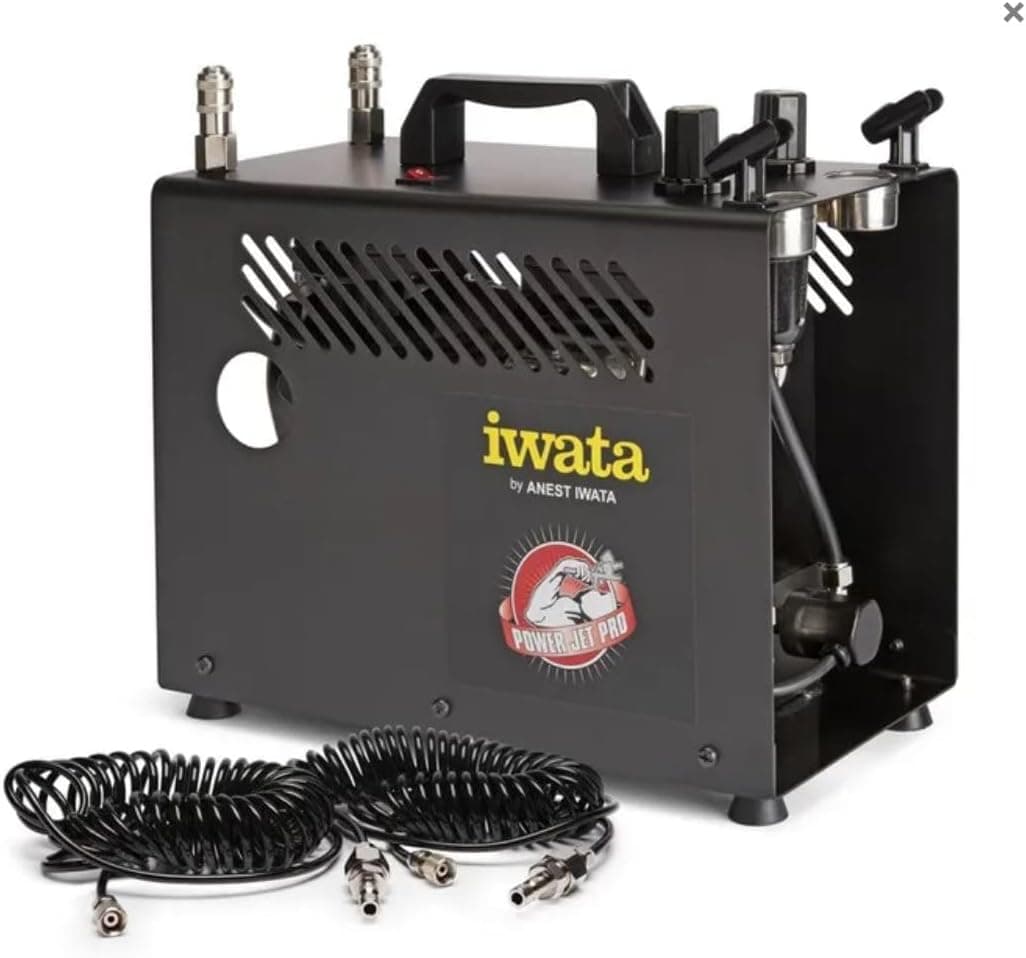
Iwata-Medea Power Jet Pro Air Compressor (IS975), a powerful, quiet compressor for serious airbrush users.
Price range: See on Amazon
What we liked
- + Power Jet Pro offers strong, steady airflow
- + Quiet operation suits indoor home workshops
- + Can support demanding airbrushes and thicker paints
Trade-offs
- - Premium price is high for occasional hobby painters
- - Heavier unit is less portable between rooms
Who this compressor suits
The Power Jet Pro is built for airbrush users who need consistent, adjustable air pressure over long working sessions, not an occasional hobbyist spraying a single small kit a few times a year. Its dual-station design lets two airbrushes run off the same unit with independent pressure control on each side, which suits a household or small studio where two people paint at once, or a single user who wants to switch between a detail airbrush and a broader spray gun without recalibrating pressure each time. A beginner buying their first compressor for occasional touch-ups on small models will likely find a smaller single-piston unit both cheaper and sufficient, reserving this tier of compressor for someone who airbrushes regularly enough to value the extra headroom and dual output.
Pressure, tank and motor specs
Listed specifications put working pressure in a 1 to 50 psi range with a maximum output cited around 70 to 75 psi depending on the source, backed by a 2 liter air storage tank that smooths out pressure pulses between the piston's strokes. The unit runs on a 1/6 horsepower motor and is rated to deliver roughly 1.08 cubic feet per minute of airflow at 60 psi, figures in line with other dual-piston compressors built for continuous airbrush use rather than occasional bursts. Two separately adjustable regulators, each with its own gauge, let each of the two output ports be set to a different pressure, which matters if one airbrush needs a fine detail pressure while the other is loaded for broader coverage.
Daily use and what keeps it running well
An auto shut-off feature stops the motor once the tank reaches its target pressure and restarts it as pressure drops during use, which reduces motor wear and noise compared with a compressor that runs continuously. Two moisture filters are built in to catch condensation before it reaches the airbrush, which matters most in humid environments or during long sessions where moisture in the air line can spit onto a model mid-spray and ruin a coat. Regularly draining any collected moisture from the filters and keeping the intake free of dust will keep pressure output consistent over time, and because this is a piston rather than diaphragm design, it benefits from being placed somewhere with reasonable airflow around the housing rather than tucked into a tight, enclosed shelf.
Trade-offs against other compressors
Against single-piston kits like Master Airbrush's G22 bundle, which pairs a smaller compressor with an airbrush and hose in one box, the Power Jet Pro is a compressor only, aimed at someone who already owns or is choosing an airbrush separately and wants a more capable air source underneath it. Against Iwata's own Studio Series Smart Jet, a lighter single-piston compressor from the same brand, this dual-station unit trades portability and a lower price for two independent outputs and a larger tank, which only pays off if you actually use two airbrushes or want the extra buffer tank capacity for demanding spraying sessions.
Verdict and who should pick something else
For builders who airbrush often, run more demanding paints that need steady pressure, or want to support two stations from a single unit, this compressor is built for that workload and earns its premium price, matching our score of 8.6 out of 10 for fit and build quality. It is a poor match for someone who only wants an affordable entry point into airbrushing or who paints occasionally in a space where a heavier, bulkier compressor is inconvenient to store or move. In those cases, a lighter single-piston compressor, even one bundled with a basic airbrush, will do the job at a lower cost and smaller footprint.
Frequently asked questions
What is the working pressure range of the Iwata Power Jet Pro?
Listed specifications put the working range around 1 to 50 psi, with a maximum output cited around 70 to 75 psi depending on the source.
Can this compressor run two airbrushes at the same time?
Yes, it has a dual-station design with two separately adjustable regulators and gauges, letting two airbrushes run at different pressures from the same unit.
Does it have an auto shut-off feature?
Yes, the compressor automatically shuts off once the tank reaches its target pressure and restarts as pressure drops during use, which reduces motor wear.
Is this compressor suitable for an occasional hobby painter?
It can be used that way, but its size, weight and price are built for regular or dual-station use, and a smaller single-piston compressor is usually a better fit for occasional painting.
Prices change often, so check the current price and availability on Amazon.
Check price on AmazonModel Build Lab may earn a commission from the link above.