Tamiya America, Inc Plastic Scriber II, TAM74091 Review (2026)
Updated September 20, 2026 · Research-based review
Our verdict
Tamiya's Plastic Scriber II uses a narrow tungsten steel hooked tip that is pulled rather than pushed through plastic, cutting a clean groove for restoring or adding panel lines. It suits builders re-scribing detail lost during seam cleanup, though it works best with a guide tape and needs replacement blades over time.
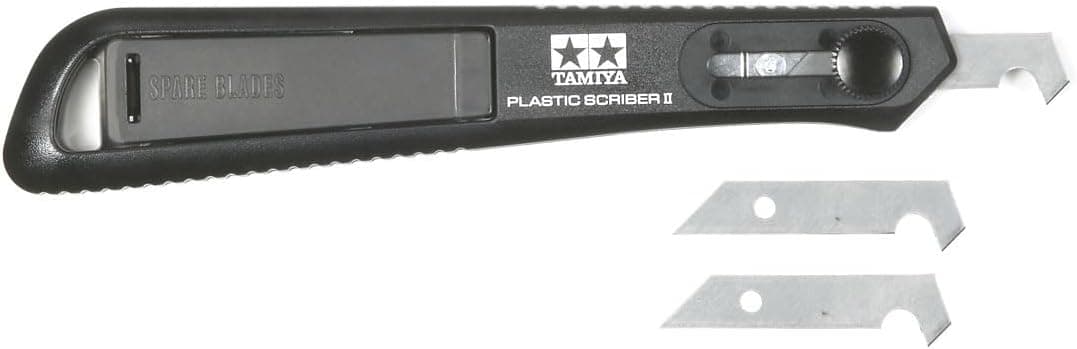
Tamiya Plastic Scriber II TAM74091, a hooked scribing tool for restoring and adding panel lines on plastic kits.
Price range: See on Amazon
What we liked
- + Hooked tip cuts clean grooves instead of pushing plastic
- + Great for re-scribing panel lines lost after sanding seams
- + Tamiya quality handle gives a steady, comfortable grip
Trade-offs
- - Needs a guide tape or template for straight lines
- - Blade dulls over time and replacement parts cost extra
How the hooked tip works
Unlike a straight scribing needle that is pushed forward through the plastic, this tool uses a narrow, tungsten steel blade with a hooked profile that is drawn back toward the user, cutting a groove as it goes rather than pushing plastic aside. This pulling action gives more control over line depth and direction, especially in tight spaces where a straight tool cannot reach or where a builder needs to feel the tip settle into an existing line. Tamiya designed this specifically to reach into hard-to-access areas of a kit, such as recessed panel gaps near raised details, where a bulkier tool would not fit.
Typical use: rescribing lost panel lines
The most common use for this tool is restoring panel lines that get sanded away when cleaning up seams on a model, since sanding a seam flat also erases any molded panel detail that crossed it. Dragging the hooked tip along the original line path, or along a fresh line laid out with tape, recuts a clean groove that matches the surrounding molded detail once painted and shaded. It is also useful for adding new panel lines that were not part of the original kit, letting a builder customize surface detail to match reference photos or a different variant of the subject.
Getting straight, consistent lines
Because the tool is guided entirely by hand, cutting a straight line freehand takes practice, and most builders pair it with a strip of drafting or masking tape laid down as a straightedge to follow, or with a flexible curve template for rounded panel lines. Without a guide, it is easy for the tip to wander slightly, which shows up clearly once panel line wash or paint highlights the groove. This is a normal limitation of hooked scribers generally rather than a flaw specific to this tool, and builders who scribe often tend to build a small kit of tapes and templates to use alongside it.
Durability and upkeep
The tungsten steel tip holds an edge reasonably well against soft styrene plastic, but like any cutting edge it will dull with repeated use, at which point lines become harder to start cleanly and may require more passes to reach the same depth. Tamiya sells this as part of its Craft Tool Series, and the handle itself is built to Tamiya's usual standard for comfort and grip during repetitive scribing work. When the tip does wear out, replacing the whole tool is generally the practical option, since spare tips are not always readily stocked the way blades are for knives.
Verdict and how it compares to a chisel-style scriber
This tool earns a 9 out of 10 for fitting the job in our data, reflecting how well suited a hooked scriber is to fine, single-width line work compared with pushing a straight needle through plastic. Builders who need only one consistent line width, mainly for seam repair and light detailing, get good value from this dedicated Tamiya tool. Those who want multiple line widths in one handle, such as for carving wider slots or varied panel styles, may prefer a chisel-style scriber with swappable blade widths instead, since this tool is built around a single fixed hooked profile that cannot be swapped for a different width later on.
Frequently asked questions
How is the Tamiya Plastic Scriber II different from a straight scribing needle?
It uses a hooked tungsten steel tip that is pulled through the plastic to cut a groove, rather than a straight needle that is pushed forward.
What is this scriber mainly used for?
It is most often used to restore panel lines that get sanded away during seam cleanup, and to add new panel lines to a kit.
Do you need a guide to scribe straight lines with this tool?
Most builders use a strip of tape or a curved template as a straightedge, since freehand lines can wander without one.
What happens when the scriber tip dulls?
Cutting becomes harder and lines need more passes; since spare tips are not commonly sold separately, replacing the whole tool is the usual option.
Prices change often, so check the current price and availability on Amazon.
Check price on AmazonModel Build Lab may earn a commission from the link above.