Tamiya 61118 1/48 Grumman F-14D Tomcat Plastic Model Airplane Kit Review (2026)
Updated September 14, 2026 · Research-based review
Our verdict
Tamiya's 1/48 F-14D Tomcat is a large, detailed swing-wing Navy fighter with moving variable sweep wings and two interchangeable parts sets. It is a rewarding but time consuming build best suited to modelers who already have some jet kit experience and shelf space to spare.
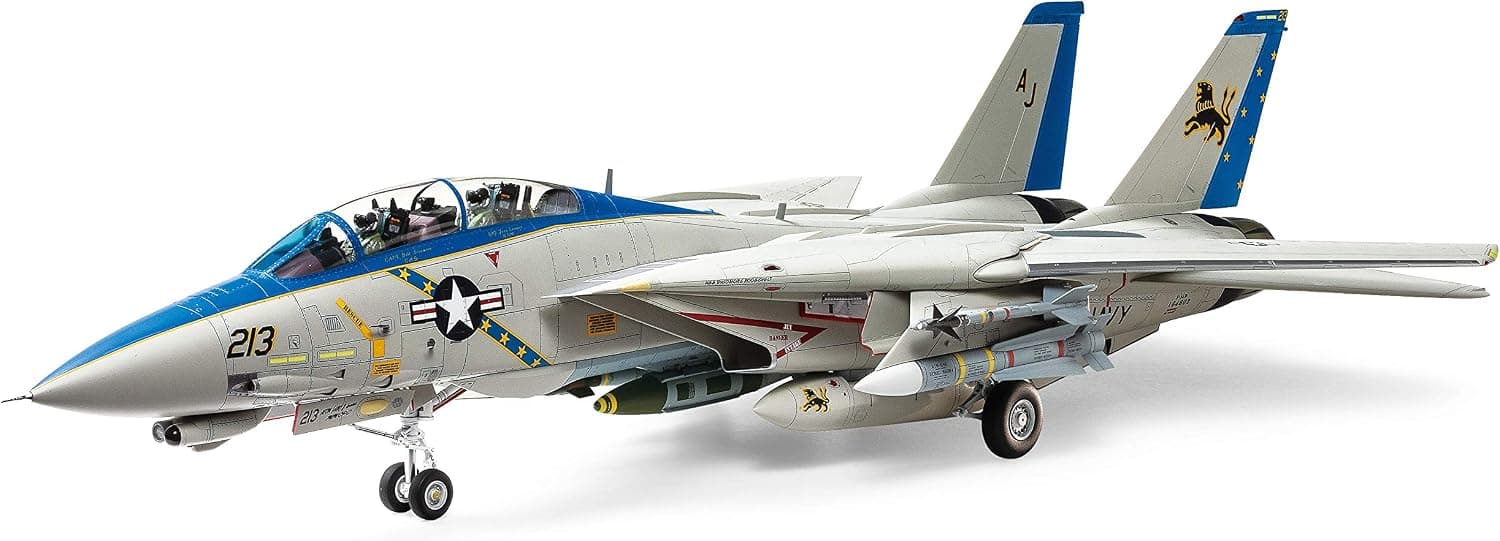
A 1/48 Grumman F-14D Tomcat from Tamiya for builders who want a large, detailed swing-wing Navy fighter.
Price range: See on Amazon
What we liked
- + Iconic Tomcat shape makes a striking shelf piece once finished
- + Tamiya's precise moldings keep the complex fuselage assembly manageable
- + Big airframe in this scale gives lots of room for panel line washes
Trade-offs
- - Wide wingspan in quarter scale needs a deep shelf or display case
- - High part count asks for patience, so it is not a quick weekend build
Who should take on the Tomcat kit
The F-14D Tomcat is one of the more recognizable Navy fighters thanks to its film appearances and long service history before being withdrawn in 2006, and Tamiya's 1/48 kit is built for modelers who want that shape rendered with real engineering rather than a simplified toy-like kit. Because of the size and part count involved, this is better suited to someone who has already built a few aircraft kits and is comfortable with a multi-session project than to a first time jet builder. Tomcat fans specifically drawn to the D model, with its General Electric F110 engines and updated digital radar and fire control systems, will appreciate that Tamiya renders those late-production details rather than only offering an earlier Tomcat variant.
Scale, size and what is in the box
At 1/48 scale the completed model has a fuselage length of about 398mm and a wingspan of roughly 408mm with the variable sweep wings set fully forward, which is a genuinely large model that needs real shelf or display case depth. Tamiya renders F-14D specific features including the distinct engine afterburner nozzles and vertical stabilizers along with fine panel lines across the airframe. The cockpit is detailed with representations of the updated instrument panels and ejection seats appropriate to the D model, and the kit includes parts for the later variants of Phoenix, Sparrow and Sidewinder air to air missiles that this Tomcat variant typically carried. Two complete sets of interchangeable parts are included so certain features can be swapped even after the model is finished.
Building a kit this size
The variable sweep wing mechanism is a functional feature rather than a fixed detail, meaning the wings can move after assembly rather than being locked in one position, which is a nice touch for display but adds complexity during the build compared with a fixed-wing kit. Tamiya's molding precision keeps the complex fuselage assembly manageable despite the high part count, though builders should expect this to be a multi weekend project rather than a quick build given the sheer number of components across the airframe, weapons and landing gear. The large wingspan also means careful handling during painting and decaling, since a wide, thin structure like this is more prone to accidental knocks than a smaller kit. As with Tamiya's other aircraft kits, paint and cement are needed separately to finish the model.
Comparing it with Tamiya's other 1/48 jets
Against Tamiya's own 1/48 F-16CJ, the Tomcat is a considerably bigger and more involved build, trading the F-16's relatively compact single engine airframe for a twin engine, swing wing design with a higher part count and a larger finished footprint. Compared with the Bf 109 G-6, a WWII prop fighter in the same product line, the Tomcat represents a jump in both scale complexity and physical size, so builders moving between eras should expect a longer build time on the Tomcat. Among other manufacturers' Tomcat kits at different scales, Tamiya's 1/48 release is generally regarded for its detail and engineering, though that comes with the tradeoff of needing a deep display shelf once finished, which is worth measuring for before buying.
Verdict for Tomcat builders
This kit rewards patience and is best suited to builders who want an iconic, large scale Navy fighter as a centerpiece model and do not mind a build that stretches across multiple sessions. The functional swing wing and twin interchangeable parts sets are genuine strengths for anyone who wants display flexibility once the model is complete. If display space is tight, or if you are looking for a faster weekend build, a smaller single engine jet kit like Tamiya's own F-16CJ would suit better. For dedicated Tomcat or naval aviation fans with the shelf space and patience to match, this remains one of the more detailed versions of the aircraft available in the scale.
Frequently asked questions
How big is the finished Tamiya F-14D Tomcat model?
It measures about 398mm long with a wingspan near 408mm at full forward sweep, so it needs a deep display shelf or case.
Do the wings actually move on the finished model?
Yes, the variable sweep wing mechanism is functional, letting the wings move after assembly rather than being fixed in one position.
Is this a good first jet kit for a beginner?
It is better suited to builders with some prior aircraft kit experience given the high part count and multi session build time.
What missile types are included with the kit?
The kit includes parts for the later variants of Phoenix, Sparrow and Sidewinder air to air missiles used by this Tomcat variant.
Prices change often, so check the current price and availability on Amazon.
Check price on AmazonModel Build Lab may earn a commission from the link above.