Pacer Adhesives Formula 560 Canopy Glue 2 oz PT56 Review (2026)
Updated September 14, 2026 · Research-based review
Our verdict
Pacer's Formula 560 Canopy Glue is a water based adhesive that dries crystal clear, making it a go to choice for fitting clear canopies and vacuum formed parts without fogging them. It suits careful, patient builders more than anyone wanting an instant bond on load bearing joints.
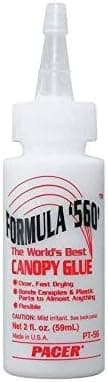
Pacer Adhesives Formula 560 Canopy Glue 2 oz PT56, a water-based glue that dries clear for canopies and clear parts.
Price range: See on Amazon
What we liked
- + Dries crystal clear so it will not fog canopies
- + Water-based formula cleans up easily before it cures
- + Flexible bond suits clear plastic to painted surfaces
Trade-offs
- - Long drying time requires holding or taping parts
- - Not strong enough for structural load-bearing joints
Who should reach for this canopy glue
Formula 560 is built for one specific job: attaching clear plastic canopies, windows and vacuum formed parts to a model without leaving the cloudy haze that many general purpose glues cause on transparent styrene. That makes it a natural fit for aircraft modelers gluing cockpit canopies, for radio control plane builders fitting large vacuum formed hoods, and for anyone assembling a display case or vehicle model with clear glazing. It is not the right choice for someone who needs an instant, rigid bond on structural parts, since the formula favors clarity and flexibility over raw holding strength. Builders who value a forgiving, repositionable glue while test fitting a canopy before final placement will get the most out of this product.
What is actually in the bottle
The glue comes in a 2 fluid ounce bottle under the Pacer Technology PT-56 part number, sold under both the Pacer and ZAP branding depending on the retailer. It is a nontoxic, water based formula rather than a solvent cement, so it does not attack clear styrene or vinyl the way some cements can, and it cleans up with water while still wet. Pacer markets it as bonding most plastics and vinyl, drying clear, and forming a flexible, shock resistant bond intended to handle vibration, which is why it shows up often in radio control aircraft builds as well as static scale kits. Beyond clear parts it also bonds to wood, foam, clay and fabric, giving it some use outside canopy work.
Living with the glue during a build
Because it is water based, Formula 560 needs time to cure rather than grabbing instantly, and manufacturers note the glue starts turning clear as it sets with full strength developing over roughly a day. In practice that means canopies and other parts need to be held, clamped or taped in position while the bond develops, which rewards patience over a rushed fit. The upside of that slower cure is a longer working window to align a canopy exactly where you want it before it locks in place, and any squeeze out wipes away with a damp cloth while still wet rather than needing solvent. Storage is straightforward since it is nontoxic and water based, though like any glue it should be kept capped between uses to avoid it drying out in the bottle.
Where it falls short and how it compares
The main trade off is bond strength: Formula 560 is not intended for structural, load bearing joints, so wings, fuselage halves or anything carrying real stress should use a proper plastic cement or epoxy instead. Against a rival like Testors Clear Parts Cement, Formula 560's water based, flexible formula tends to be gentler on delicate vacuum formed plastic, while solvent based clear cements can bond faster but risk fogging if applied too heavily. Microscale's Micro Krystal Klear is a similar water based clear glue aimed at the same job, so the choice between them often comes down to bottle size, applicator tip and personal habit rather than a large difference in results. Users should also expect the long drying time to mean extra taping or clamping steps compared with faster setting cements.
Verdict and who should look elsewhere
This is a smart, inexpensive addition to a model building bench for anyone who regularly fits clear canopies, windows or vacuum formed parts and wants a glue that will not haze the plastic. It rewards builders willing to hold or tape parts in place while the water based formula cures rather than expecting an instant set. Skip it if you need a strong structural adhesive for load bearing joints, since that is explicitly outside what this glue is designed to do, and reach for a standard plastic cement or epoxy instead. For canopy work specifically, it remains a well regarded, widely used option among aircraft and radio control modelers.
Frequently asked questions
Will Formula 560 fog or cloud a clear plastic canopy?
No, it is formulated to dry crystal clear, which is why it is a common choice for canopies and other clear parts.
How long does the glue take to fully cure?
It starts turning clear as it sets, with full strength developing over roughly 24 hours, so parts should be held or taped in position during that time.
Can I use this glue on structural model joints?
No, it is not strong enough for load bearing joints, so use a standard plastic cement or epoxy for structural assembly.
Does it clean up easily if I get excess glue on a part?
Yes, because it is water based you can wipe away squeeze out with a damp cloth before it cures.
Prices change often, so check the current price and availability on Amazon.
Check price on AmazonModel Build Lab may earn a commission from the link above.