ZAP Glue ZAP Formula 560 Canopy Glue PAAPT56 Review (2026)
Updated September 14, 2026 · Research-based review
Our verdict
Zap's Formula 560 suits modelers gluing clear canopies onto plastic aircraft or RC bodies who need a glue that will not fog acetate or dry brittle. The main strength is a flexible, crystal-clear bond that shrugs off vibration; the trade-off is a slow cure that asks for patience and careful taping.
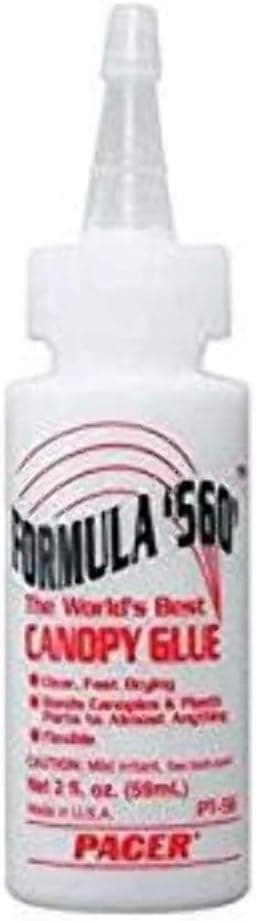
ZAP Formula 560 Canopy Glue PAAPT56, the same popular canopy glue sold under the Zap brand for clear parts.
Price range: See on Amazon
What we liked
- + Formula 560 is widely recommended for canopy fitting
- + Can fill small gaps around clear parts neatly
- + Remains slightly flexible for durable clear joints
Trade-offs
- - Check the bottle volume in the listing before ordering
- - Needs patience while it cures fully clear
Who this canopy glue is built for
Formula 560 is aimed squarely at modelers fitting clear parts, most commonly plastic aircraft canopies and vacuum-formed ABS windows on RC planes, cars and boats. Because it dries clear and stays flexible rather than going rigid, it is the kind of glue builders reach for specifically when a regular plastic cement or thick cyanoacrylate would risk fogging or cracking a clear part under vibration. It also works on wood, clay, plaster, foam and fabric, so scratch-builders use it beyond canopies for general craft bonding where clarity or flexibility matters. Builders who just need a fast structural bond between two styrene parts are better off with a standard plastic cement instead.
How the formula works and what it comes in
It is a water-based, nontoxic adhesive that cleans up with water while wet, which matters given how often canopy work involves careful masking nearby. Several hobby retailers list the bottle at 2 fluid ounces under the PT-56 part number, useful to know since the product's own listing does not spell out the volume. The glue migrates into small gaps to form a complete seal rather than just bonding two flat surfaces, and it forms a firm, flexible bond described as able to withstand shock and vibration once fully cured, which suits the light buffeting a flying model's canopy takes in use.
Applying it and waiting it out
Fit the clear part as snugly as possible before applying glue, since the adhesive is meant to wick into the remaining gap rather than fill a loose fit on its own. After applying a thin bead, the part needs to be clamped or taped in place for several hours until the glue turns from milky to clear, and full strength is reached only after about 24 hours, with temperature and humidity affecting how long that takes. Because the formula is water-based, keep the bottle away from freezing temperatures in storage, since freezing can ruin an otherwise unopened bottle before it is even used.
Trade-offs against other clear-part adhesives
Solvent-based options like Testor's Clear Parts Cement or Microscale's Micro Krystal Klear set up differently and some builders prefer their handling, but Formula 560's water-based, nontoxic formula and flexible cured bond are exactly why it stays a common pick for canopy work despite the longer wait to full strength. Pacer's own branded version of Formula 560 sells in the same 2 oz size under a nearly identical part number, so builders sourcing it under either the Zap or Pacer label are effectively getting the same glue. Compared with general purpose plastic cements, this is a slower, more specialized product suited to clear parts specifically rather than everyday assembly, and reaching for it on a standard styrene joint instead of a canopy would mean waiting far longer than the job needs for no real benefit in strength. Many builders end up keeping both a fast styrene cement and a bottle of this on the bench, since the two rarely overlap in what they are actually asked to glue during a typical build.
Verdict and who should pick something else
For gluing canopies, windows or other clear plastic parts where fogging or a brittle bond would ruin the look, Formula 560 remains a dependable, purpose-built choice, and its water cleanup makes it forgiving of small mistakes while wet. Builders who need a fast set for structural styrene joints should reach for a standard plastic cement instead, since waiting hours to overnight for this glue to reach strength will slow down general assembly work considerably. Keep a small bottle in the kit box specifically for canopy day, rather than expecting it to double as an everyday assembly cement, and its slow cure stops being a downside once it is used for the job it was actually built for.
Frequently asked questions
Will it fog a clear plastic canopy?
No, it is formulated to dry clear and is specifically designed for attaching airplane canopies and vacuum-formed ABS parts without clouding them.
How long until it is fully cured?
Plan on several hours of clamping or taping until it turns clear, with full strength reached around 24 hours later.
Can it be used on materials besides clear plastic?
Yes, beyond canopies it also bonds wood, clay, plaster, foam and fabric.
Does it need special storage?
Yes, because it is a water-based formula it should be kept away from freezing temperatures.
Prices change often, so check the current price and availability on Amazon.
Check price on AmazonModel Build Lab may earn a commission from the link above.