Estes 1427 Alpha III Rocket Launch Set with Launch Pad and Controller Review (2026)
Updated September 14, 2026 · Research-based review
Our verdict
The Estes Alpha III Launch Set pairs a proven beginner rocket with the Porta-Pad II pad and Electron Beam controller, so a first time flyer only needs to add engines and igniters. It suits kids, families and classroom groups getting started, not builders chasing altitude records or scratch designs.
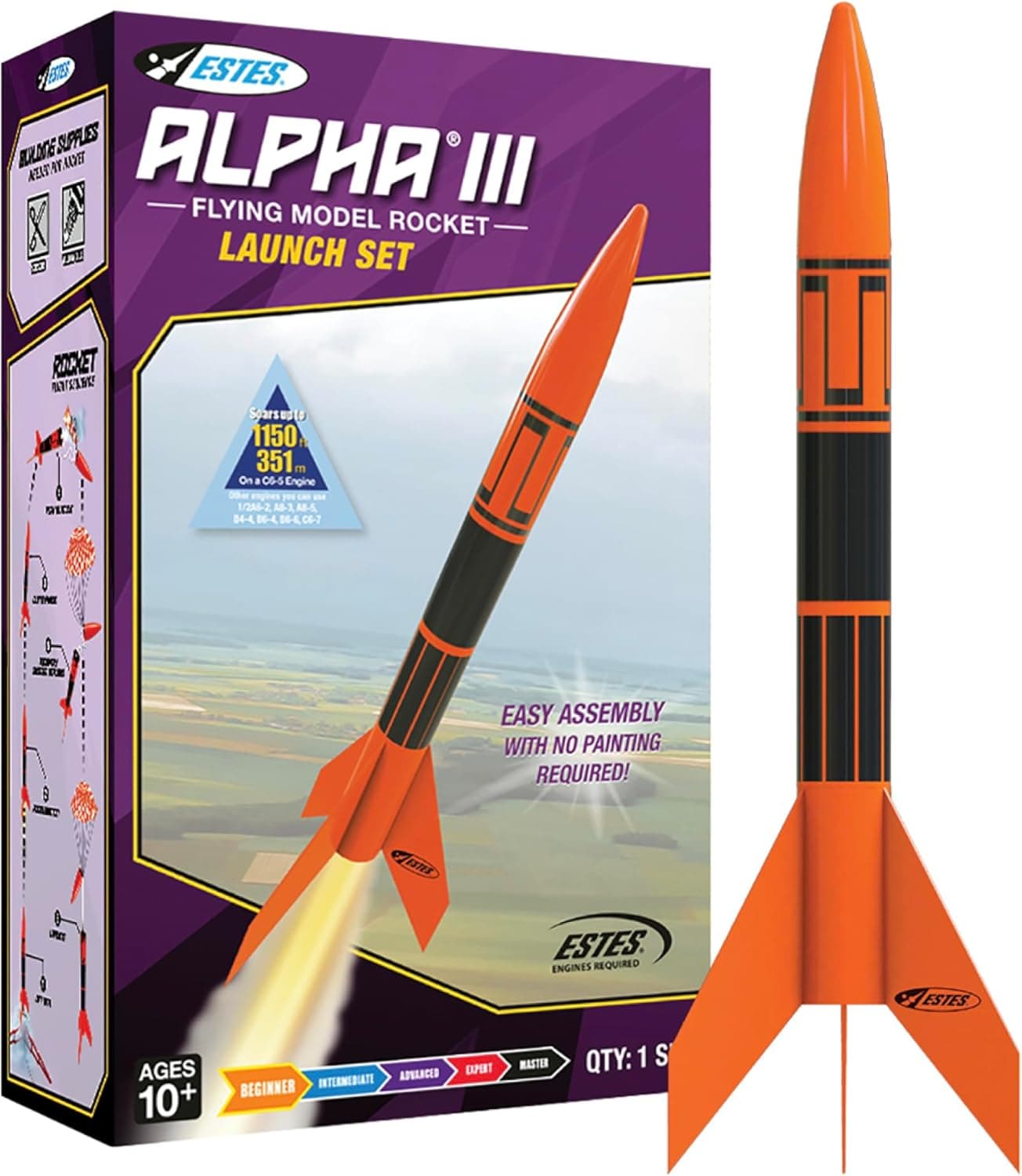
Estes 1427 Alpha III Rocket Launch Set with launch pad and controller, a classic starter kit for first model rocket flights.
Price range: See on Amazon
What we liked
- + Launch pad and controller are included, so you only add engines
- + Alpha III is a proven design used by many clubs and schools
- + Simple assembly gets beginners flying within a short session
Trade-offs
- - Engines and igniters must be bought separately before launch
- - Needs an open field clear of trees, which limits where you fly
Who the Alpha III launch set is built for
This set is aimed squarely at first time rocketeers, and Estes rates it E2X, meaning easy to assemble compared with kits that need separate fin alignment and fillets. The Alpha III body tube, nose cone and fin unit go together with basic household glue, which makes it a common pick for parents introducing kids to the hobby, for scout groups and for classroom science units on flight. Because the launch pad and electronic controller are already in the box, a buyer is not stuck piecing together a system from several listings before a first flight. Experienced modelers who already own a pad and want a second or third rocket to fly are better served by a rocket only kit, since they will not need another controller taking up storage space. For anyone starting from zero, the completeness of this set is the main selling point.
Rocket dimensions and what is actually included
The Alpha III itself measures about 12.3 inches long and just under an inch in diameter, weighs roughly 1.2 ounces, and Estes lists a projected altitude near 1150 feet on a suitable engine. Recovery is handled by a 12 inch parachute rather than streamer recovery, which gives a gentler, more visible descent that is easier for young flyers to track and retrieve. The box includes the rocket parts, decals, engine mount, parachute, the Porta-Pad II launch pad and the Electron Beam launch controller with safety key and continuity check light. Estes lists the rocket as compatible with a range of A, B and C impulse engines such as A8-3, B6-4 and C6-5, which lets the same airframe fly higher or lower depending on which engine is loaded for that flight.
Getting it built and to the launch field
Assembly leans on ordinary hobby glue and typically takes under an hour, with no paint required to get the rocket flight ready, though many owners add paint or decals for a more finished look. Engines and igniters are not included and have to be bought separately before any launch, which is worth budgeting for alongside the set itself. Because ejection charges and motor exhaust involve real combustion, Estes and most clubs require flying in an open field well clear of trees, power lines and dry grass, so a small backyard is rarely enough space. The parachute recovery means a gentle landing in most conditions, but retrieval still depends on wind carrying the rocket away from obstacles, so scouting the field before the first flight helps avoid a rocket stuck in a tree on day one.
How it stacks up against other starter sets
Against the Estes Tandem-X set, which ships with two rockets sharing one pad, the Alpha III trades quantity for a single larger, more capable airframe that many clubs use as a reference beginner design. Compared with Quest Aerospace's Astra kits, which are typically smaller and lighter with their own separate launch systems, the Alpha III set has the advantage of bundling pad and controller so there is one less compatibility question to sort out. None of these entry sets include engines, so the ongoing cost of A through C impulse motors applies across the board and should factor into which starter set makes sense for a given budget. For a first rocket that a whole family can watch fly repeatedly, the Alpha III's size and altitude sit in a comfortable middle ground.
Verdict on who should pick the Alpha III
Buy this set if you are outfitting a first time flyer, a classroom, or a scout troop and want pad, controller and rocket in one order rather than juggling separate compatibility checks. It is also a sensible pick for anyone who wants a proven, widely flown design rather than a newer or unusual kit shape. Skip it if you already own a launch pad and controller, since you would be paying again for hardware you do not need, or if you are after a bigger, higher flying rocket for a more advanced second build. Remember that engines, igniters and recovery wadding are recurring purchases on top of the set, and that a genuinely open flying field is a requirement, not a nice to have, before the first countdown.
Frequently asked questions
Do engines come with the Estes Alpha III set?
No, engines and igniters are sold separately and must be bought before your first launch.
How much open space does the Alpha III need to fly safely?
You need a clear field well away from trees, power lines and dry brush, since the projected altitude runs close to 1150 feet on a suitable engine.
Is the rocket reusable after each flight?
Yes, the parachute recovery system is designed for repeated flights, so you reload a fresh engine and igniter each time you fly.
What skill level is the Alpha III rated for?
Estes rates it E2X, its easy to assemble line, which is meant for first time builders using basic household glue.
Prices change often, so check the current price and availability on Amazon.
Check price on AmazonModel Build Lab may earn a commission from the link above.